The Statutes of the
Religious and Military Constantinian Order of Saint George
– under the Rule of St. Basil –
Dated, Cannes, 20th July 1934; amended 16th July 1943
and on 31st October 1987 and 31st October 2006.
(English translation from the Spanish; cf. https://ordenconstantiniana.org)
CHAPTER I: PURPOSE OF THE ORDER
The Religious and Military Constantinian Order of Saint George is a chivalric religious Order which, from its most ancient origins, has set itself the glorification of the Cross, the propagation of the Faith, and the defence of the Holy Roman Church as its aims; with which it is closely bound by reason of the singular merits it acquired in the East in combat against the Infidel, and by virtue of the many tokens of gratitude and goodwill bestowed upon it by the Supreme Pontiffs.
It is therefore not merely the foremost duty of Knights to live as perfect Christians; it shall likewise be their obligation to associate themselves with all those institutions that contribute to the advancement of religious principles in society, and to employ every means at their disposal towards the restoration of Christian life in practice.
In order further to strengthen its secular institutions and to bring them into conformity with the exigencies of the age, which by its development has transformed the entire fabric of contemporary society, the Order likewise intends to make its utmost contribution to measures and activities in support of the great and eminently social works of hospital relief and charity.
The Order, having maintained its age-old institutions and adapted them to the requirements of the times – which by their development have transformed the fabric of contemporary society – further intends to make its utmost contribution to social endeavours and works of a charitable and benevolent nature, in particular in the nursing of the sick and in works of mercy.
CHAPTER II: GRADES OF THE ORDER AND NUMBER OF KNIGHTS
ARTICLE I
The grades of the Order are as follows:
a) Bailiff Knights Grand Cross of Justice (Bailíos Caballeros Grandes Cruces de Justicia)
b) Knights and Dames Grand Cross of Justice (Caballeros y Damas Grandes Cruces de Justicia)
c) Knights and Dames Grand Cross Iure Sanguinis (Caballeros y Damas Grandes Cruces Iure Sanguinis)
d) Knights and Dames Grand Cross of Merit (Caballeros y Damas Grandes Cruces de Mérito)
e) Knights and Dames of Justice (Caballeros y Damas de Justicia)
f) Knights and Dames Iure Sanguinis (Caballeros y Damas Iure Sanguinis)
g) Knights and Dames of Merit (Caballeros y Damas de Mérito)
h) Knights and Dames of Office (Cross of Merit) (Caballeros y Damas de Ufficio (Cruz al Mérito)
i) Chaplains (Capellanes)
Commanders are Knights of the various categories who have donated or bequeathed a portion of their estate to the Order, thereby rendering distinguished service unto it.
ARTICLE II
The number of Bailiff Knights Grand Cross of Justice shall not exceed fifty, in remembrance of the select personages whom Constantine the Great chose to guard the Labarum; each of them bears the title of one of the ancient Bailiwicks or Priories and is styled “Excellency” and “Don”.
Exempt from this number are Royal Princes and Cardinals.
The number of Knights Grand Cross of Justice, of Knights Grand Cross Iure Sanguinis, and of Knights Grand Cross of Merit (de Mérito) is limited to one hundred and fifty.
The number of Dames Grand Cross of Justice, of Dames Grand Cross Iure Sanguinis, and of Dames Grand Cross of Merit (de Mérito) is likewise limited to one hundred and fifty. The number of Knights and Dames of the other grades is, by contrast, unlimited.
CHAPTER III: CONDITIONS FOR ADMISSION
The Constantinian Cross may be conferred upon persons of any nationality who profess the Roman Catholic Apostolic Faith and are endowed with those virtues befitting a perfect Christian knight.
ARTICLE I
The conferment of the Order pertains to the Grand Master, in accordance with the following provisions:
a) The dignity of Bailiff Knight Grand Cross of Justice is reserved for Sovereigns, Royal Princes, Cardinals of the Holy Roman Church, and representatives of the most illustrious noble families.
b) The Grand Cross for Knights of Justice is reserved for representatives of the most illustrious noble families who have distinguished themselves by extraordinary service to the Order. This distinction may likewise be conferred upon Sovereigns, Royal Princesses, and certain ladies of the highest social rank. For these Knights and Dames it is requisite to possess noble lineage of at least two hundred years in all four branches of the family, a criterion demanded of the entire category of Knights and Dames of Justice.
c) The Grand Cross for Knights and Dames of the grade Iure Sanguinis is reserved for those who are of noble birth, hold high dignities or offices of distinction, or have distinguished themselves by extraordinary service to the Order.
d) The Grand Cross for Knights and Dames of Merit (de Mérito) is reserved for those who hold high offices, have been recipients of high distinctions, and have distinguished themselves by extraordinary service to the Order or to the Church.
e) The Cross for Knights and Dames of Justice is reserved exclusively for those who furnish proof of nobility through all four paternal and maternal lines of descent, in accordance with the ancient statutory provision, the Magisterial Decree of 17th April 1762, and the provision of 10th January 1850, or pursuant to the provisions of the present Rules.
f) The dignity of Knight and Dame Iure Sanguinis may be conferred upon persons who, pursuant to the Despatch of 5th February 1855, are unable to pass all the proofs required in the category of Justice, but who belong to families of ancient, attested, and proven nobility.
A Regulation for the administration and examination of the proofs of nobility for admission to the categories of Knights of Justice or Iure Sanguinis shall be appended to the Statutes, together with the nobility provisions contained in the Royal Despatch of 29th November 1804, in the Despatch of 9th February 1849, and in that of 10th January 1850.
g) The Cross for Knights and Dames of Merit (de Mérito) may be conferred upon persons of merit, whether by reason of their personal qualities or for services rendered to the Order, in particular of a religious nature.
h) The Cross of Office for Knights and Dames (La Cruz de Ufficio) may be conferred upon those who have served the Order by personal merit, also known as “recognition of merit”.
i) Chaplains are priests who have rendered, or are in a position to render, useful services to the Order in the exercise of their ministry. They often fulfil an important rôle in the support and spiritual accompaniment of the community.
ARTICLE II
The minimum age for admission into the Order is set at eighteen years.
ARTICLE III
Ecclesiastics are permitted to aspire to any of the foregoing grades, provided they fulfil the requisite conditions.
ARTICLE IV
The Grand Master reserves to himself the right to confer the Cross of the Order motu proprio, notwithstanding the provisions of Articles II and III, having regard to the numerical limits of the higher categories.
CHAPTER IV: DECORATIONS, INSIGNIA, AND UNIFORM OF THE ORDER
ARTICLE I
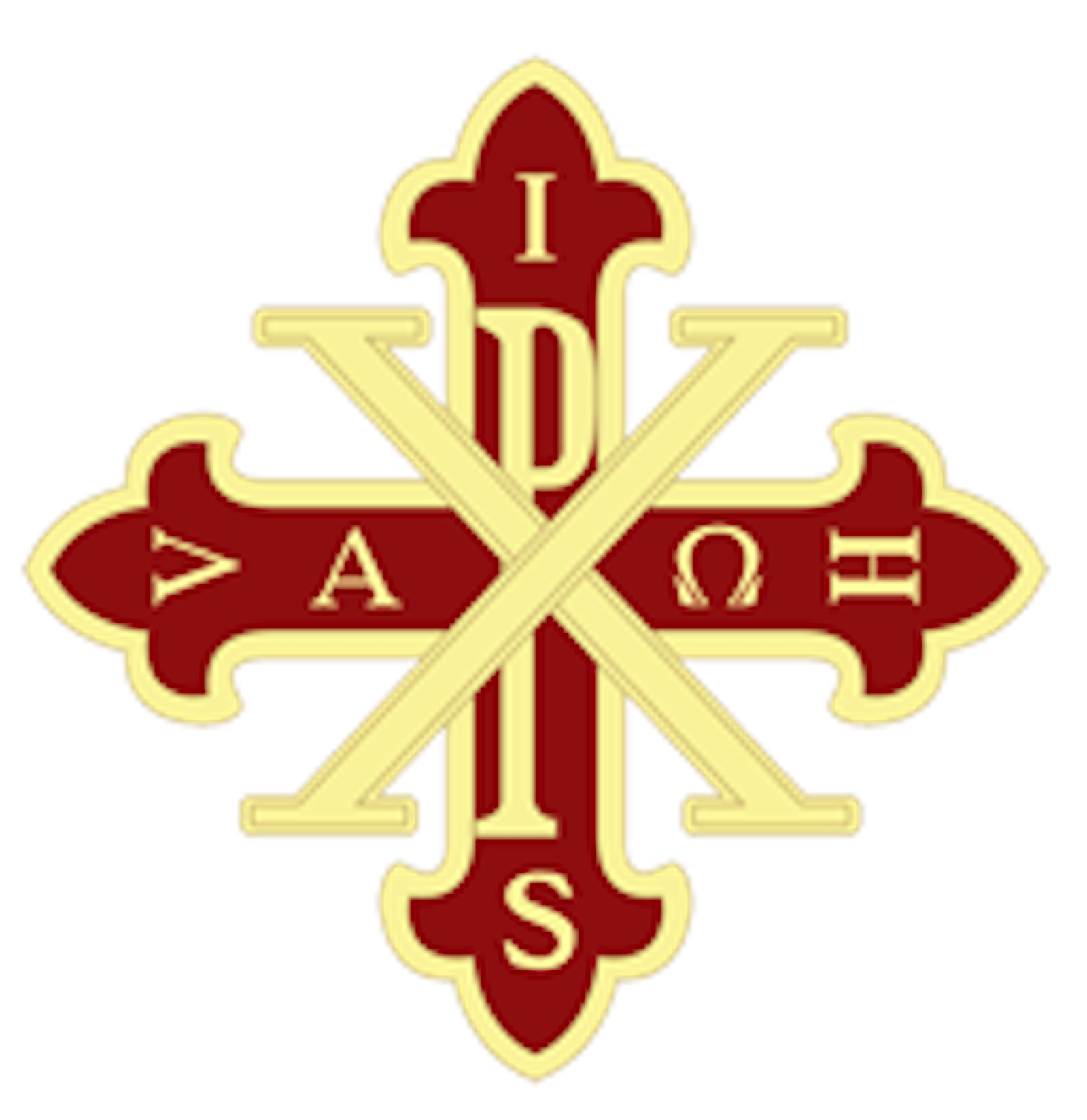
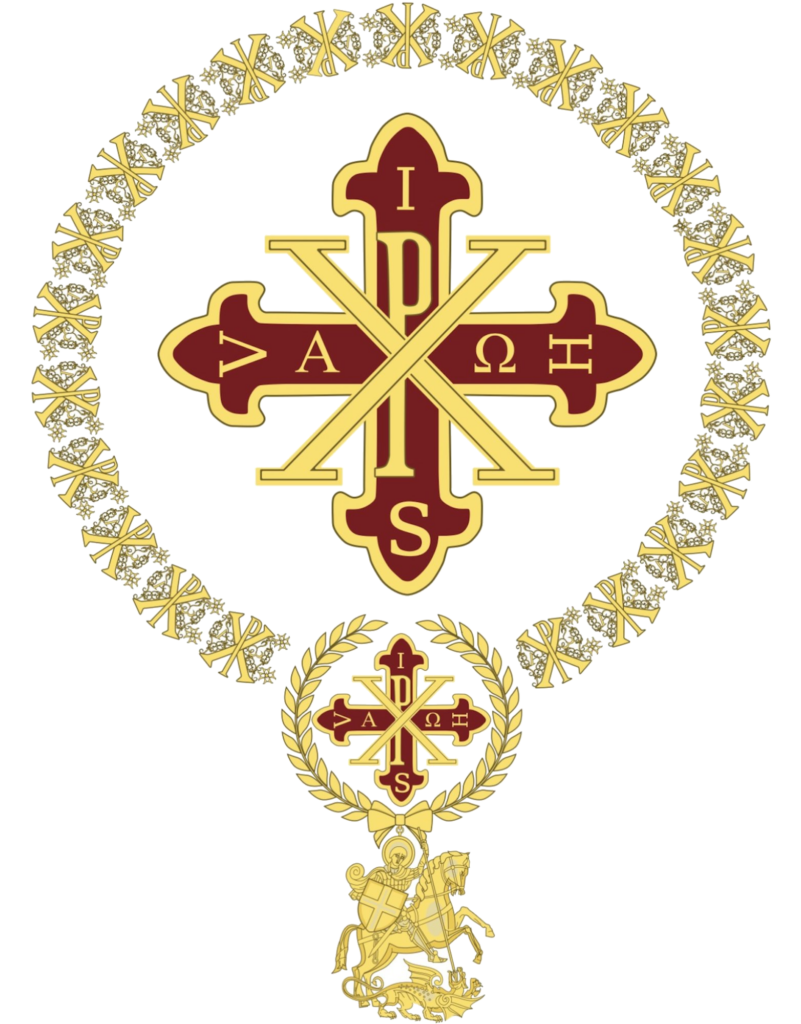
The Cross of the Religious and Military Constantinian Order of Saint George is a lily cross (fleur-de-lis) fashioned of gilt metal, enamelled in red with gold edging and overlaid with purple enamel. Superimposed in the centre in gold is the great Christogram XP, flanked by the Greek letters Alpha and Omega, and at its extremities the letters I.H.S.V. for the Order’s motto ‘In Hoc Signo Vinces’ (In This Sign Thou Shalt Conquer). The Order’s ribbon is of sky-blue moiré.
ARTICLE II
The Bailiff Knights Grand Cross of Justice wear the Cross of the Order, 5 cm in breadth, surmounted by the Royal Crown and the Military Trophy in gold, with Saint George on horseback (3 cm in breadth) at its foot, depicted wounding the dragon; the whole is suspended from a broad sky-blue moiré sash of 10 cm width, passing from the right shoulder to the left side.
The said Knights additionally wear upon the left side of the breast a filigree breast star of 9 cm diameter, composed of eight silver rays tipped with gold, bearing the Cross of the Order.
The Bailiff Knights Grand Cross of Justice may, if they are Heads of Royal Families or hold high offices within the Order, be authorised by special personal written permission of the Grand Master to wear the Constantinian Collar, which consists of Constantinian monograms and bears in the centre Saint George on horseback. The Knights Grand Cross of Justice wear the same insignia as the Bailiff Grand Crosses, save without Saint George on horseback.
The Dames of the Grand Cross wear a decoration one-third smaller than that of the Knights (and this size is uniform for all categories of Dames), surmounted only by the Royal Crown without Saint George on horseback. The decoration is suspended from a sash of 5 cm width of undulated sky-blue moiré, passing from the right shoulder to the left hip. The star worn upon the left side of the breast is one-third smaller than those of the Knights.
ARTICLE III
The Knights Grand Cross Iure Sanguinis and of Merit (de Mérito) wear the same badge as the Bailiff Knights Grand Cross of Justice, save without the badge of Saint George as a Knight and without the Military badge above the Royal Crown, in the case of Iure Sanguinis; and without Saint George, the Military badge, and the Crown, in the case of the grade de Mérito.
Knights Grand Cross Iure Sanguinis and of Merit (de Mérito) wear the badge in silver rather than gold, save by Motu Proprio of the Grand Master.
The Dames Grand Cross Iure Sanguinis and of Merit (de Mérito) wear the same insignia as the Dames of the Justice Grand Cross, save without the Royal Crown upon the Cross. They wear the breast star in silver rather than gold, excepting a Motu Proprio of the Grand Master.
ARTICLE IV
The Knights of Justice wear the Cross of the Order, 4.5 cm in breadth, with the Royal Crown and the Military Trophy, suspended from a 5 cm broad band of undulated silk about the neck. They likewise wear the breast star, identical to that of the two preceding categories of Knights.
The Dames of this category wear the Cross of the Order in the same size as the Dames of the Grand Cross, suspended from an undulated sky-blue moiré ribbon upon the left shoulder. They wear a plaque identical to that of the Dames Grand Cross.
ARTICLE V
The Knights Iure Sanguinis wear the same Order about the neck as the Knights of Justice, save without the Military Trophy. The star is of silver rather than gold, save by Motu Proprio of the Grand Master.
The Dames Iure Sanguinis wear upon the left shoulder the same Order as the Dames of Justice. The star is of silver rather than gold.
ARTICLE VI
Knights of Merit wear the Cross of the Order without the Royal Crown and without the Military Trophy about the neck. They wear the silver star only if appointed by the Grand Master by Motu Proprio.
The Dames of this class of the Order wear the decoration of the Order, suspended from a ribbon, upon the left side, without the Royal Crown upon the Cross; they wear no badge.
ARTICLE VII
The Cross of Office (Cruz de Ufficio) for Knights and Dames is worn without the Cross of the Order and without the Royal Crown, on a ribbon of blue undulated silk of 4.5 and 3.0 cm respectively, to be worn upon the left side of the breast.
ARTICLE VIII
Chaplains wear about the neck, upon a blue silk lace, the Cross of the Order surmounted only by the Royal Crown.
Upon the left side of their breast they wear, pursuant to the Royal Decree of 27th October 1815, a silver star one-third smaller than those of the Knights, whose rays are set within the arms of the Cross.
ARTICLE IX
The lay Constantinian Knights may wear the uniform approved by Magisterial Decree of 12th February 1912.
Pursuant to this Decree, the uniform consists of a tunic and breeches in royal blue (bleu de roi) with bands on the breeches, epaulettes, and a gold belt, collar, and white vestments embroidered in gold according to rank, all in accordance with the illustrations appended to the said Decree.
The hat is of the same form as those of the other orders of chivalry and is furnished with a cockade of sky-blue moiré silk. They bear sword and spurs.
ARTICLE X
At religious ceremonies, lay Knights and Dames may wear the ceremonial mantle of royal blue fabric (bleu de roy) approved for the various categories by Magisterial Decree, bearing the Cross of the Order 25 cm in breadth upon the left side; the mantle collar is of red velvet, ornamented with gold embroidery according to rank, and is clasped by two round fibulae bearing the Cross of the Order encircled by laurel leaves and connected by a gold chain.
CHAPTER V: OFFICES AND DIGNITIES
ARTICLE I
The supreme Regent and foremost dignitary of the Order is the Grand Master, with all the traditional rights contained in the special grants and Bulls of the Supreme Pontiffs.
The office of Grand Master, which is reserved to the House of Bourbon as heirs of the House of Farnese, is transmitted by hereditary succession; in default of heirs, the succession passes by testamentary disposition; failing this, all the Bailiff Knights Grand Cross of Justice shall assemble according to ancient custom and in the spirit of the Farnesian Statutes approved by the Holy See, to elect from amongst their number a new Grand Master.
ARTICLE II
The election is conducted by secret ballot, and the Knight is declared elected who has obtained the greatest number of votes in the aggregate over three consecutive ballots.
In the exceptional case of equal votes, the election of the Grand Prefect is conducted openly and weighted doubly.
ARTICLE III
In accordance with custom, the Grand Master shall petition the Holy Father to appoint an Ecclesiastical Council for the Order, which, as Grand Prior, shall represent the bonds of traditional and filial devotion that the military Order has ever maintained with the Church.
ARTICLE IV
The Grand Master appoints a Grand Prefect, a Grand Chancellor, a Grand Prior, a Grand Treasurer, an Auditor-General, and a Secretary. He further appoints at least twelve Councillors who, together with the aforementioned persons, form the Deputation responsible for the governance of the Order.
CHAPTER VI: GOVERNMENT OF THE ORDER
ARTICLE I
The moral, disciplinary, and administrative direction of the Order is entrusted by the Grand Master to the Deputation, which is composed of at least eighteen members and has its seat in Madrid.
The Deputation is composed of the Grand Prefect, the four Grand Offices of the Order, the Secretary, and the other members of the Council, all appointed by the Grand Master.
The Grand Prefect is ordinarily the President of the Deputation.
The Vice-Presidents (ordinarily two) are chosen by the Grand Master from among the Council members who hold no office; one of the Vice-Presidents may be granted the title of First Vice-President.
ARTICLE II
The Deputation: It superintends the general organisation of all civil and religious works in conformity with the aims of the Order. It submits to the Grand Master proposals for the admission of Knights and Dames who fulfil the requisite conditions, and excludes from the Order those who are unworthy of membership. It draws up the budget, governs the administration and civil works of the Order, and determines the divine services in concert with the Grand Prior. It deliberates upon the financial administration and draws up each year a report submitted to the Grand Master for approval. It determines the entire ceremonial of the Order. It deliberates upon all matters concerning the Order and the application of revenues, subject to the assent of the Grand Master.
ARTICLE III
The powers of the President of the Deputation are: The convocation of the Deputation and the conduct of its sessions. He ensures the implementation of the resolutions adopted by the Deputation. With the assistance of the Secretary, to examine the accounts and to have a special report drawn up, signed by those concerned. He presents to the Deputation the account rendered by the Grand Treasurer and transmits it to the Grand Master for approval. Signature of the official correspondence with the Grand Master and also (if not entrusted to the Grand Chancellor or Secretary) with authorities, bodies, etc. Verification of the regularity of all branches of service.
ARTICLE IV
In the case of the absence or incapacity of the President, the First Vice-President assumes his duties.
CHAPTER VII: POWERS OF THE OFFICES
ARTICLE I
The Grand Prefect is the first authority of the Order after the Grand Master and ordinarily represents him.
In the case of the absence of the Grand Master or during his minority, he assumes the latter’s duties. In the former case, he ensures that within a period of six months all the Bailiff Knights who are Knights Grand Cross of Justice convene for the election of the new Grand Master (see Art. I of Chap. V).
ARTICLE II
The Grand Chancellor is charged with the Chancery of the Order. He keeps all documents relating to the appointments of Knights, signs the Letters Patent of appointment, signs the payment orders and forwards them to the Grand Treasurer for execution. In the case of the absence or incapacity of the Grand Chancellor, the Vice Grand Chancellor assumes his duties.
ARTICLE III
The Grand Prior, Ecclesiastical Counsellor of the Deputation, has spiritual oversight of the Order and direct supervision of the Chaplains.
He is chosen from the most eminent ecclesiastics of the Order, and if he does not already possess the Grand Cross, it is conferred upon him upon his appointment as Grand Prior, in which case he is not in any event counted within the number of one hundred and fifty persons established in Chapter II, Article II. In the case of the absence or incapacity of the Grand Prior, one of the Vice Grand Priors assumes his duties.
The Presidents of the National Commissions may, with the consent of the Grand Master and for the promotion of the best spiritual direction of the Order, appoint a Chief Chaplain for their respective nation, who shall assist the Grand Prior or the Vice Grand Priors in their duties.
ARTICLE IV
The Grand Treasurer, or the office entrusted by the Grand Master with his duties, has the delicate charge of guarding the treasury of the Order, and is the sole officer authorised to handle the financial resources of the Order.
He executes the payment orders directed to him, collects the sums in the name of the Order, and issues the corresponding receipts. Annually (ordinarily in April) he presents to the Deputation the final accounts for the year closed on 31st December, together with the budget for the current year.
In the absence or incapacity of the Grand Treasurer, the Deputy Grand Treasurer or the office entrusted with his duties performs his functions.
ARTICLE V
The title of Grand Inquisitor is replaced by “Auditor-General”. The Auditor-General watches over the precise observance of the statutory provisions of the Order and reports to the Grand Prefect when he finds that Constantinian Knights have violated their chivalric duties, and the latter in turn informs the Deputation so that, where appropriate, suitable measures may be taken.
ARTICLE VI
The Secretary of the Deputation assists the Grand Chancellor in the conduct of the Chancery and the handling of correspondence; he keeps the registers and minutes of the Order, issues the summonses of the Deputation, and draws up the minutes of the sessions of the Deputation and of the Presidential Council.
ARTICLE VII
For the better functioning of the Order, national commissions or associations, coordinators, and delegates may be appointed as representatives with territorial jurisdiction.
ARTICLE VIII
National Associations of the Constantinian Order of Knighthood, affiliated to the International Association with its seat in Madrid, are permitted in the various countries. In this case, the appointment of the Presidents of the Associations, after consultation with the Deputation, is decided by the Grand Master, to whom the Statutes of the Constantinian Associations must likewise be submitted for approval.
CHAPTER VIII: SESSIONS AND DELIBERATIONS
ARTICLE I
The Deputation meets in ordinary and extraordinary sessions. Ordinary sessions are held twice yearly (ordinarily in April and November).
Extraordinary sessions are held upon the order of the Grand Master, upon convocation by the President, or upon the request of at least seven members of the Deputation.
Sessions of the Deputation are valid only if at least six members are present, including the President or one of the Vice-Presidents and one of the Grand Offices (Grandes Cargos).
The number of sessions of the Presidential Council is not fixed.
Extraordinary sessions of the Presidential Council are valid only if at least four members of the Council are present.
ARTICLE II
Every member of the Deputation has the right to make such proposals as he deems appropriate. Should these be rejected, the proposer may have his vote recorded in the minutes of the deliberation.
CHAPTER IX: SACRED FUNCTIONS
The sacred functions are determined by the Grand Prior in concert with the Deputation and with the consent of the Grand Master.
CHAPTER X: STANDARD OF THE ORDER
The Standard of the Order at great assemblies and sacred ceremonies is the Constantinian Labarum, fashioned in the likeness of the historical Labarum of Constantine the Great.
The Standard employed at civil occasions in support of hospitals, relief organisations, and charitable bodies is the white silk banner bearing the Constantinian Cross in the centre in purple.
FINAL PROVISION
The present Statutes do not alter the privileges which the Holy Apostolic See has in the past granted to the Religious and Military Constantinian Order of Saint George and to its members.
Cannes, 20th July 1934, 16th July 1943.
FERDINANDO DI BORBONE, Duke of Calabria
Amended 31st October 1987 and 31st October 2006
CARLOS DE BORBON,
Infante of Spain, Duke of Calabria
His Royal Highness Don Carlos of Bourbon of the Two Sicilies and Bourbon Parma, Infante of Spain, Duke of Calabria, Count of Caserta, Head of the Royal Dynasty and Family of the Two Sicilies, by the Grace of God and hereditary right, eleventh Grand Master of the Sacred and Military Constantinian Order of the Knights of Saint George.
CARLO DE BORBÓNE, Duke of Calabria
Hereby it is decreed that the Statutes of the Sacred Military Order, promulgated by His Royal Highness Don Ferdinand Pio di Borbone Dos Sicilias, Duke of Calabria, ninth Grand Master of the Order, on 16th July 1943, and amended on 31st October 1987 with effect from 1st January 1968, are extended as follows:
ONE: By special concession of His Royal Highness the Grand Master and in accordance with the traditions of the Order, the Constantinian Cross may, in extraordinary circumstances, be conferred upon Christian ladies and gentlemen who are of high lineage or have performed great public deeds, but who do not profess the Catholic, Apostolic, and Roman religion.
TWO: These concessions respect the same categories and grades and the same conditions of lineage that are in force, but bear the title and designation of “Honour”. The new categories are therefore: Honour and Justice, Honour and Iure Sanguinis, and Honour and Merit; and the grades are those of Bailiff Grand Cross of Honour and Justice, of Knight and Dame Grand Cross of each of the three categories, of Knight and Dame of each of the three categories, and of Knight of Honour and Office.
THREE: The gentlemen and ladies upon whom the Constantinian Cross of Honour has been conferred are not members of the Constantinian Order, but consider themselves as having been decorated with the Constantinian Cross. The conferment of the Constantinian Cross of Honour may be suspended or revoked in circumstances under which a member of the Order would be suspended or struck from the roll.
FOUR: The names of the Knights and Dames decorated with the Constantinian Cross of Honour appear in the Roll of the Order immediately after the names of the members of the Order belonging to the corresponding category. They wear the same decorations as the members of the Order.
FIVE: Those Knights and Dames of the Constantinian Order who do not profess the Roman Catholic Apostolic religion and who, by virtue of a special concession of His Royal Highness the Grand Master or his predecessors, are already members of the Order, are forthwith received into the category of “Honour”.
Madrid, 19th September 1998, Feast of Saint Januarius
CARLOS, DUKE OF CALABRIA G.M.