The House of Bourbon-Two Sicilies
The House of Bourbon-Two Sicilies is an Italian cadet branch of the Spanish Bourbons, tracing its origin to Ferdinand (1751–1825), the third son of King Charles III of Spain (1716–1788), which held sovereign dominion over Southern Italy and Sicily for upwards of a century during the eighteenth and nineteenth centuries. Its descent is traced in legitimate male line from the Capetian dynasty, through Philip, Duke of Anjou — subsequently Philip V of Spain — a younger grandson of Louis XIV of France (1638–1715), whose accession to the Spanish throne in 1700 established the Bourbon dynasty in that kingdom.
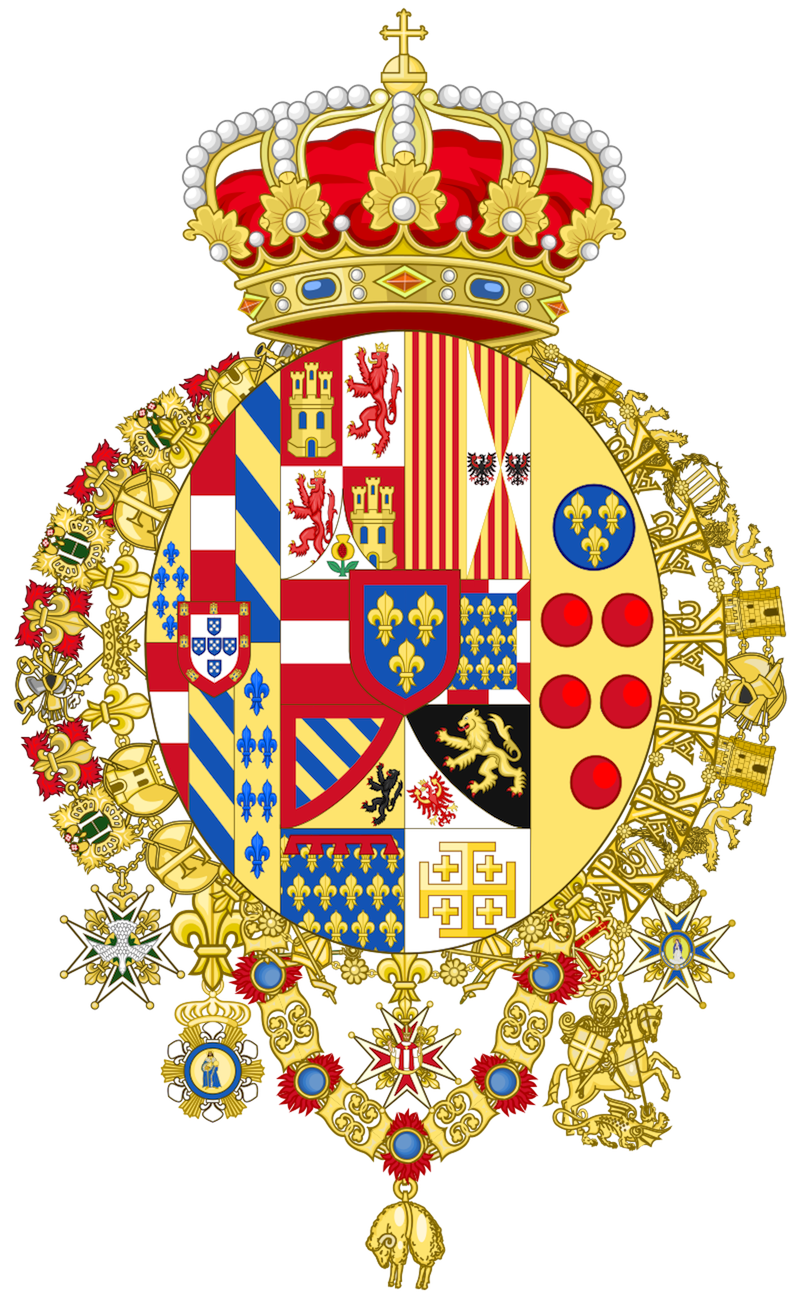
The Foundation of the Dynasty (1734)
The dynasty of Bourbon-Two Sicilies came into being in the year 1734 under circumstances of singular political moment. Don Carlos de Borbón (1716–1788), the younger son of King Philip V of Spain by his second consort, Elisabeth Farnese, led an army into southern Italy during the course of the War of the Polish Succession (1733–1738) and defeated the Austrian Habsburgs, who had held dominion over the territory since 1707. Upon the conclusion of that swift campaign, he ascended the throne on the 15th of May 1735 at Palermo, as Charles VII of Naples and King of Sicily. For the first time in centuries, an independent sovereignty had been established that did not function as a viceroyalty of a foreign power — southern Italy was governed by a native monarch who regarded himself as a sovereign prince, not as a deputy of another crown.
The Bourbon inheritance of Charles was, from the very outset, conjoined with the dynastic traditions of the Farnese. His mother, Elisabeth Farnese, was the last distinguished bearer of that illustrious family, which had ranked amongst the most powerful dynasties of Italy since the fifteenth century. Through her, Charles inherited the Grand Mastership of the Religious and Military Constantinian Order of Saint George — one of the most ancient dynastic orders of chivalry in Europe — together with the Duchies of Parma and Piacenza. Thus he assumed the cultural, religious, and dynastic heritage of two great Italian dynasties simultaneously: those of the Spanish Bourbons and of the Farnese. This double provenance shaped from the beginning the character and self-understanding of the new House.
The Pragmatic Sanction of 1759 and the Separation of the Crowns
When Charles was called to the throne of Spain in 1759 upon the death of his half-brother Ferdinand VI, he was confronted with a decision of fundamental dynastic consequence. The European powers had expressly stipulated in the Peace of Utrecht of 1713 that Spain and the Italian territories might not be governed in personal union. Charles was therefore compelled to designate one of his sons as King of Naples-Sicily, whilst he himself withdrew to Spain as Charles III. On the 6th of October 1759, Charles issued the instrument known as the Pragmatic Sanction, which inscribed in perpetuity the separation of the two dynastic branches. His third son, Ferdinand (1751–1825) — the elder sons being considered unfit to reign or reserved for Spain — remained at Naples and assumed the government as Ferdinand IV of Naples. The Pragmatic Sanction thereby established an independent line of primogeniture for the House of Bourbon-Two Sicilies, distinct from the Spanish branch. This autonomy — together with the principle of agnatic primogeniture as the governing rule of succession — has remained unaltered to the present day.
The Era of Reform and Cultural Flourishing (1734–1806)
Under the reign of Charles III and during the early decades of his son Ferdinand IV, the Kingdom of Naples experienced an intensive period of enlightened absolutism. The Bourbon monarchs oriented themselves by the ideas of the European Enlightenment: they sought to curtail the influence of the Church, to rationalise the system of taxation, and to reorganise the administration upon modern principles. Particularly remarkable was their systematic assault upon the privileges of the nobility and of ecclesiastical institutions — a course of action that had scarcely any parallel in other European monarchies of the period.
Under Charles III, a number of institutions of enduring cultural significance came into being at Naples:
- The Teatro San Carlo, inaugurated in 1737, was upon its opening the largest opera house in Europe and is held to this day to be amongst the most magnificent in the world.
- The excavations of Herculaneum (from 1738) and Pompeii (from 1748) were initiated under Bourbon patronage and rendered Naples the centre of European scholarly interest in classical antiquity. The discoveries effected a revolution in the understanding of Roman daily life and established the modern science of archaeology.
- The Royal Palace of Caserta, commenced in 1752 to the designs of Luigi Vanvitelli, constitutes one of the most imposing palace complexes of eighteenth-century Europe — a masterwork of architecture and landscape gardening that is to-day inscribed upon the UNESCO World Heritage List.
- Neapolitan composers such as Giovanni Paisiello and Domenico Cimarosa attained renown throughout Europe and exercised a formative influence upon the musical life of their age far beyond the confines of Italy.
- Naples ranked alongside Paris and London as one of the most populous cities of the continent and was accounted an indispensable destination upon the Grand Tour.
The Napoleonic Wars and the Union of the Kingdoms (1806–1816)
The Napoleonic Wars subjected the House of Bourbon-Two Sicilies to threats of an existential character. Ferdinand IV was twice expelled from the mainland by French forces: from 1799 to 1802 the Parthenopean Republic held sway on the peninsula, and from 1806 to 1815 the Kingdom of Naples was governed first by Joseph Bonaparte and thereafter by Joachim Murat. Ferdinand resided upon the island of Sicily during these years, under the protection of the British fleet.
After the fall of Napoleon and the Congress of Vienna (1814–15), Ferdinand returned to the mainland. On the 8th of December 1816 he united the hitherto separate Kingdoms of Naples and Sicily into the Kingdom of the Two Sicilies and assumed the title of Ferdinand I, King of the Two Sicilies. This union was designed to promote the cohesion of the state and the efficiency of its administration, but it likewise gave rise to a persistent conflict with Sicily, which was thereby deprived of its constitutional privileges.
The Kingdom of the Two Sicilies (1816–1861)
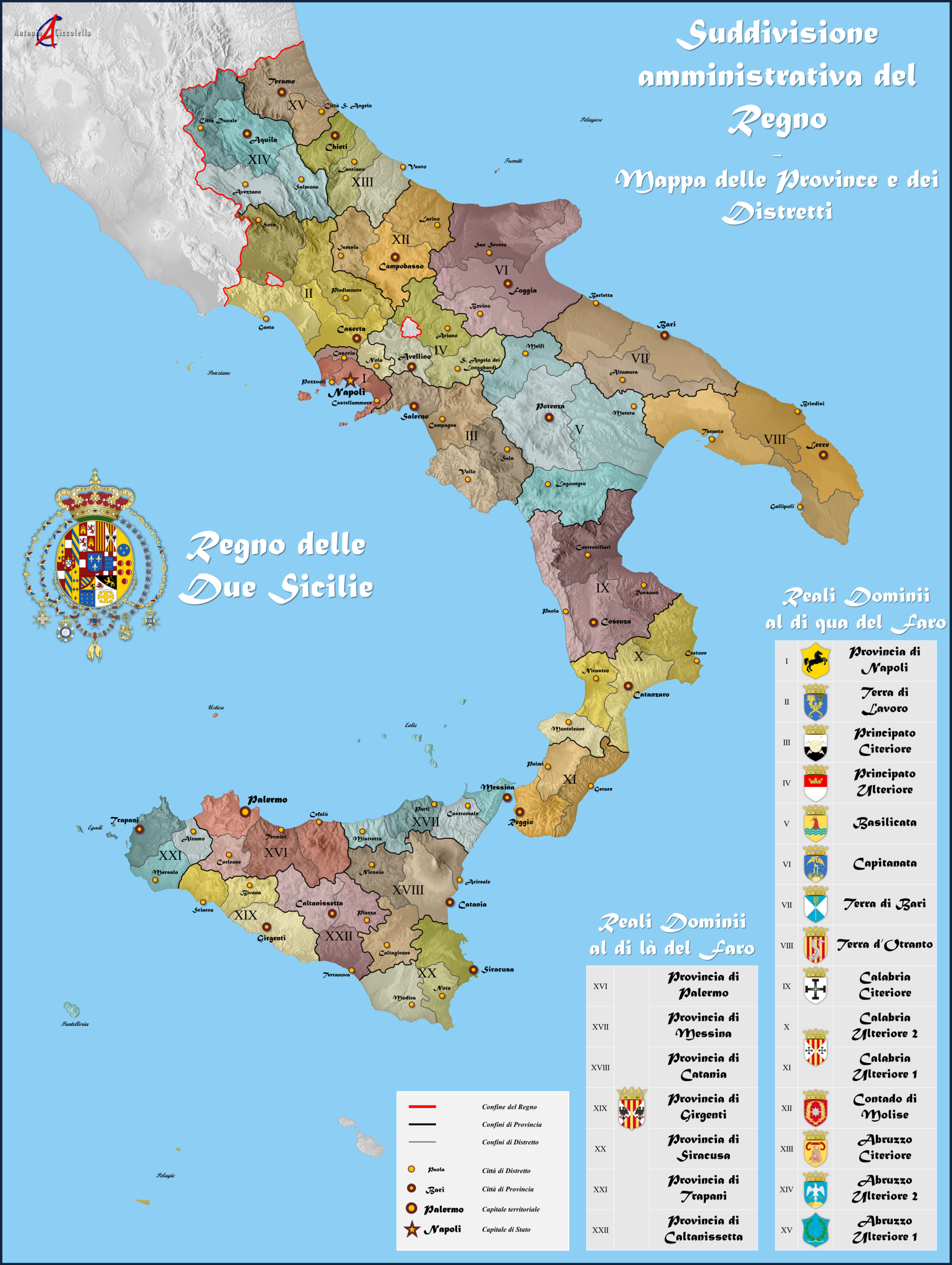
The Kingdom of the Two Sicilies encompassed the whole of the southern third of the Italian peninsula together with the island of Sicily — in all, some 113,000 square kilometres, with a population of approximately nine million souls. It was thereby, in point of territorial extent, the largest single state upon the peninsula. The capital, Naples, was numbered amongst the most populous cities of Europe.
Economically, the kingdom lagged behind northern Italy. Its agrarian structure was dominated by feudal landowners of great estate; the process of industrialisation advanced more slowly than in the north; and social reforms were frequently frustrated by the resistance of the aristocracy and the Church. Nevertheless, during the reign of Ferdinand II (r. 1830–1859), the first railway upon the Italian peninsula was opened (Naples–Portici, 1839), a telegraphic network was established, and regular steamship services were inaugurated. The reign of Ferdinand II was, at the same time, marked by severe political repression — the revolutions of 1848 were suppressed by force of arms.
The Territorial Structure of the Kingdom
The administrative organisation of the state comprised numerous provinces, distributed both upon the Italian mainland and upon the island of Sicily. The map below illustrates the extent and the provincial structure of the Bourbon state:
The End of the Monarchy and the Risorgimento (1860–61)
The Kingdom of the Two Sicilies came to its end under circumstances of high drama. In May 1860, Giuseppe Garibaldi landed upon Sicily with his Mille — the Thousand Volunteers — and commenced the campaign that was to bring down the kingdom within a matter of months. The last reigning sovereign, Francis II (1836–1894), suffered defeat in successive engagements, lost Naples, and withdrew to the fortress of Gaeta, where he maintained his resistance with great resolution until the last. On the 13th of February 1861, Gaeta fell; Francis II and his consort, Marie Sophie of Bavaria — who had earned a European reputation for her courageous conduct in the defence of the fortress — went into exile. The territory of the kingdom was incorporated into the newly proclaimed Kingdom of Italy.
It may be observed that, in the years preceding 1860, the Kingdom of the Two Sicilies recorded annual growth of approximately 5 per cent—the highest on the Italian peninsula—maintained a favourable balance of payments, and saw its government bonds traded significantly above par (at around 118) in 1858. By contrast, the process of Italian unification was accompanied by economic decline and considerable political tension; Italian government bonds were trading well below par by 1875. The conduct of the plebiscite has likewise been subject to critical scrutiny in the historiography, particularly with regard to the absence of a secret ballot, administrative influence, and high levels of illiteracy. Attention is also drawn to the substantial military presence in the South and to the large number of political imprisonments during the 1860s.
Following 1861, and the departure of the royal couple from Gaeta, the deposed sovereigns resided in Rome until 1870, where they retained significant possessions deriving from the Farnese and Medici inheritances, including the Palazzo Farnese, the Farnesina, and the Villa Madama. Their titulature (from 1815) comprised not only that of King of the Two Sicilies, but also King of Jerusalem, Grand Prince of Tuscany, and Duke of Castro as part of the Farnese inheritance. The material basis of these dynastic claims was progressively diminished or alienated over the course of the nineteenth and twentieth centuries.
Francis II and Marie Sophie resided thereafter chiefly at Paris and Rome, where they continued to champion the legitimist cause. Despite several attempts — supported by papal diplomacy and legitimist circles throughout Europe — all endeavours to restore the monarchy proved unavailing. Francis II died in 1894 at Arco in the Tyrol, without legitimate issue.
The Continuation of the Dynasty in Exile (from 1894)
Upon the death of Francis II without male heirs, the position of Head of the House passed to his younger brother Alfonso, Count of Caserta (1841–1934). Alfonso was one of the central figures of the dynasty in exile: he maintained the dynastic connexions with the other royal houses of Europe, upheld the traditions of the House, and ensured that the question of legitimate succession remained present to the consciousness of legitimist circles on the continent. Alfonso married Antonietta of Bourbon-Sicily (1851–1938), and by this union had eleven children, of whom the sons were destined to play a decisive rôle in the subsequent history of the dynasty.
The generation of Alfonso’s sons that proved decisive for all subsequent history comprised three princes of particular consequence:
- Ferdinand Pius (1869–1960), Duke of Calabria — the eldest son; Head of the House and Grand Master from 1934 until his death in 1960, having died without issue. His death gave rise to the contest of succession.
- Carlos (1870–1949) — the second son; progenitor of the Calabria Line. He subscribed in 1900 to the Act of Cannes; he was married first to María de las Mercedes, Princess of Asturias, and subsequently to Luisa d’Orléans. His line continues to the present day.
- Ranieri (1883–1973), styled Duke of Castro — the third son; progenitor of the Castro Line. In 1960 he advanced a unilateral claim to the headship of the House and the Grand Mastership — a claim contrary to the rules of agnatic primogeniture.
The Two Lines of the House
Since 1960, genealogical studies and dynastic-legal analyses have distinguished between two lines of the dynasty, both tracing their descent from Alfonso, Count of Caserta: the legitimate senior line of Calabria, and the agnatic line of Castro.
Even without entering into detail (the foundations and the dynastic-legal assessment of this distinction are set out in detail on the Q&A page under Question 15): The genealogical position of the Castro line may be stated plainly. Ranieri (1883–1973) was the third son of Alfonso, Count of Caserta (1841–1934). Ranieri was thereby genealogically junior to the descendants of the elder sons of Alfonso — in particular to the line of the second son Ferdinand Pius and to the line of the firstborn son (which passed through Carlos into the Calabria line). The decisive point follows from this: in 1960, the succession did not fall to Ranieri’s descendants, but to the line of the firstborn son Carlos and thus to the Calabria line.
The decisive point is this: the Castro line has no further male descendants. Prince Charles, Duke of Castro has daughters only. This means that the Castro line, according to the traditional rules of agnatic primogeniture, becomes extinct in the male line with the generation of Prince Carlo. This raises the question of the dynastic significance of the Salic Law claims that the Castro line advanced for decades: precisely the same Salic Law that was once invoked to exclude the Calabria line now condemns the Castro line itself to dynastic extinction.