Insignia and Prerogatives
Classes and Grades of the Order
The Religious and Military Constantinian Order of Saint George is divided into several categories, which differ according to the origin, merits, or functions of their members. The classes of the Order are as follows: Justice – Iure Sanguinis – Merit and Office. Within the first three categories, various grades may be conferred, including the Grand Cross.
Ladies were first admitted to the Order by a reform of the Statutes in the year 1908. At present, all categories and grades are in principle open to them, save for the dignity of Bailiff.
The Grand Master may distinguish Knights or Ladies of the Merit category by conferring upon them a silver breast cross, thereby marking them within their grade. He may likewise confer upon members of the Iure Sanguinis category a golden breast cross verleihen, constituting a particular distinction within that category. These awards represent a special honour within their respective categories.
The dignity of Bailiff may be conferred upon Knights Grand Cross of the Justice category. Cardinals and royal princes are traditionally received as Bailiffs Grand Cross of Justice. Their number is limited to fifty, in remembrance of the tradition of the fifty guardians of the Labarum of Constantine. The number of the remaining Grand Crosses of the three categories is restricted to 150 Knights and 75 Ladies.
These distinctions constitute a particular honour within their respective categories.
Merit Medals
In addition to the classes of the Order, Merit Medals may likewise be awarded for distinguished service to the Order. This distinction does not, however, constitute membership therein. The Merit Medal is comprised of three classes: Gold – Silver – Bronze
Zu besonderen Anlässen wurden darüber hinaus eigene Gedenkmedaillen gestiftet. Im Jahr 2016, anlässlich des Heiligen Jahres der Barmherzigkeit, wurde eine Medaille geschaffen, die einmalig an die Teilnehmer der Feierlichkeiten des Ordens in Rom verliehen wurde. Sie wurde in zwei Klassen ausgegeben: Gold und Silber. Zum dreihundertsten Jahrestag der päpstlichen Bulle Militantis Ecclesiae von Papst Clemens XI. (27. Mai 1718) wurde im Jahr 2018 eine weitere Gedenkmedaille gestiftet, ebenfalls in den Klassen Gold und Silber. Für die Teilnehmer der Internationalen Constantinischen Wallfahrt sowie des feierlichen Pontifikalamtes zu Ehren des heiligen Georg im Heiligen Jahr der Hoffnung 2025 wurde schließlich die Verdienstmedaille „Jubiläum der Hoffnung 2025“ gestiftet, die in einer Klasse – Silber – verliehen wird.
The Ceremonial Mantle of the Order
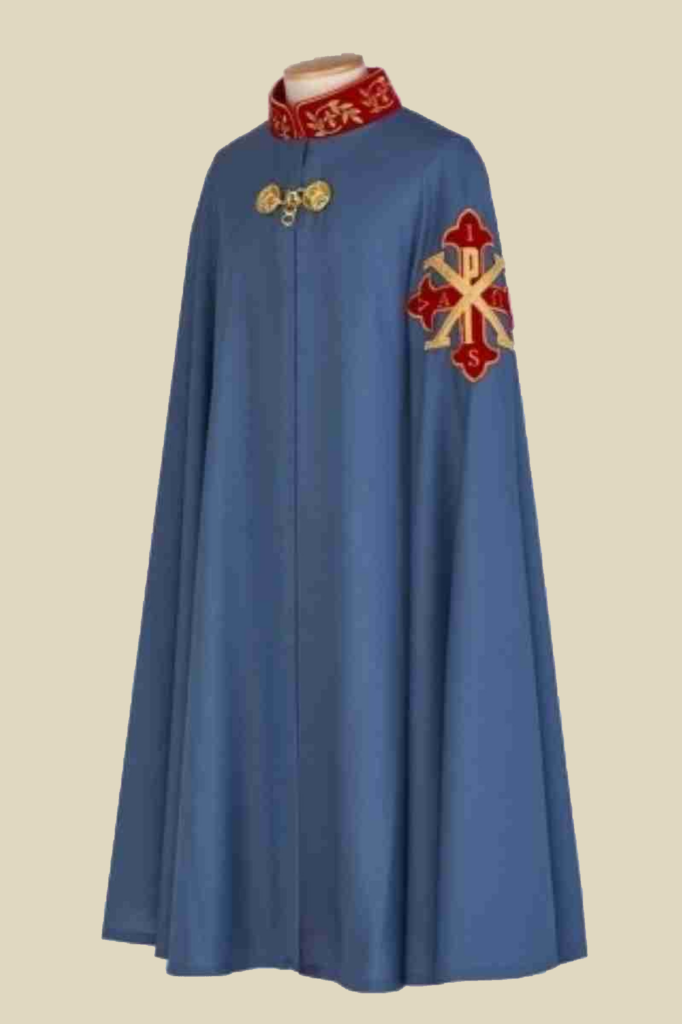
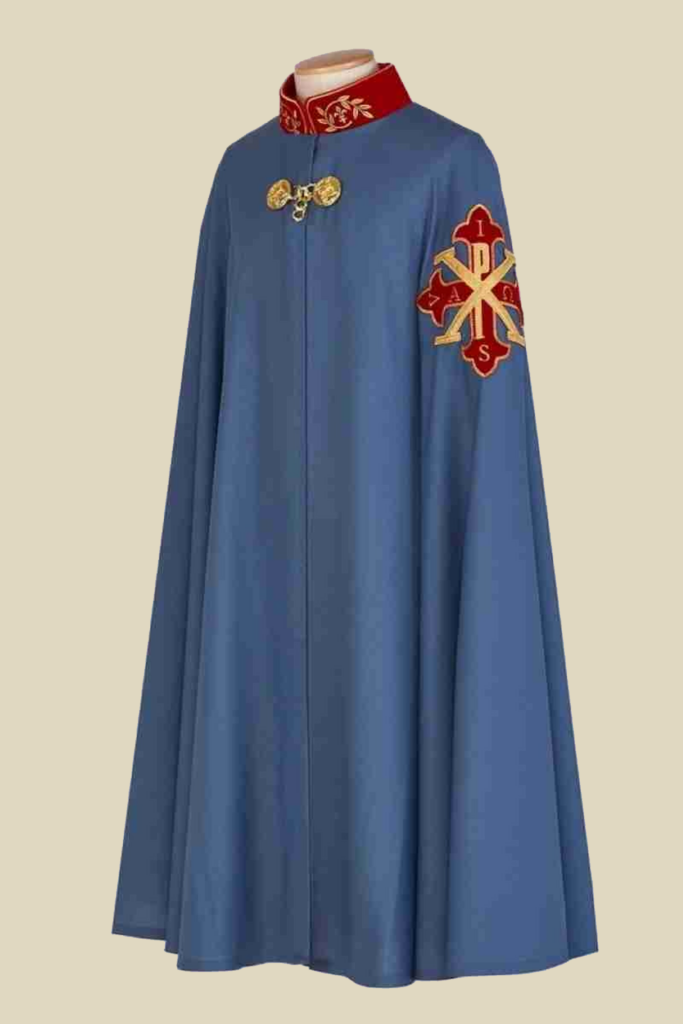
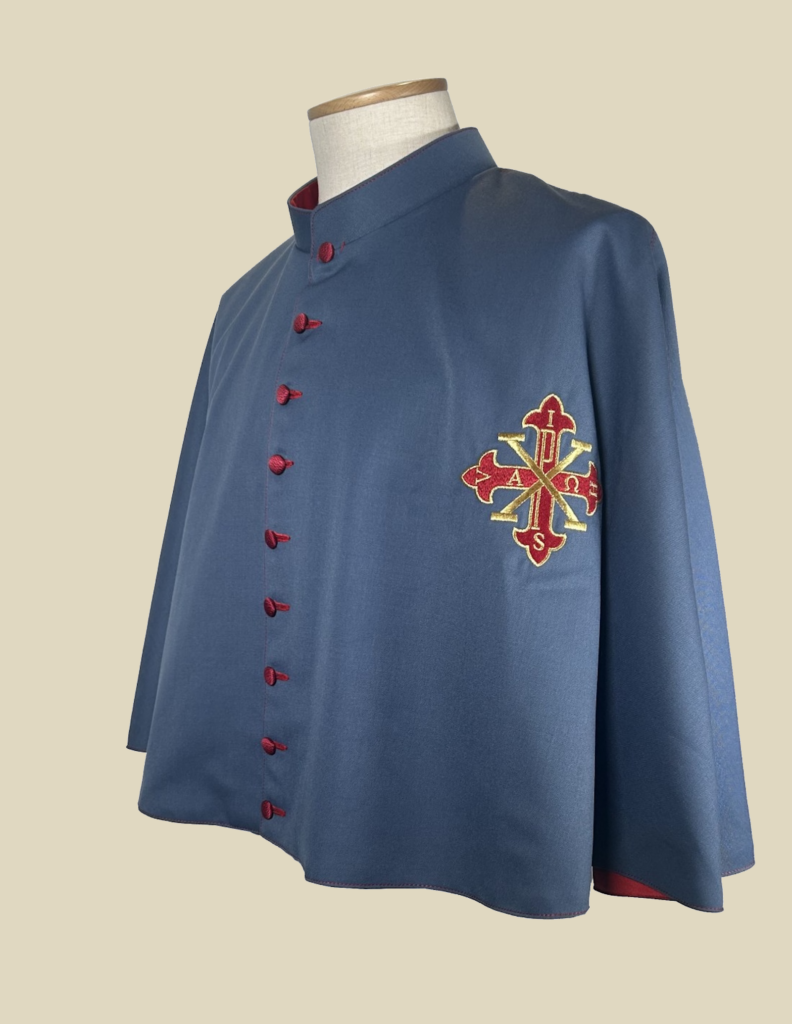
The Constantinian ceremonial mantle is fashioned of light royal-blue woollen cloth, lined in red. Upon the left shoulder is embroidered the Constantinian Cross, twenty-five centimetres in breadth, wrought in gold thread upon purple velvet. The mantle is fastened by two round gilt metal clasps of fifty millimetres in diameter, bearing the Constantinian Cross within a laurel wreath, and joined by a gilt chain of thorns. The collar is fifty-five millimetres in height and is made of purple velvet, in accordance with the respective category.
The Constantinian Cross
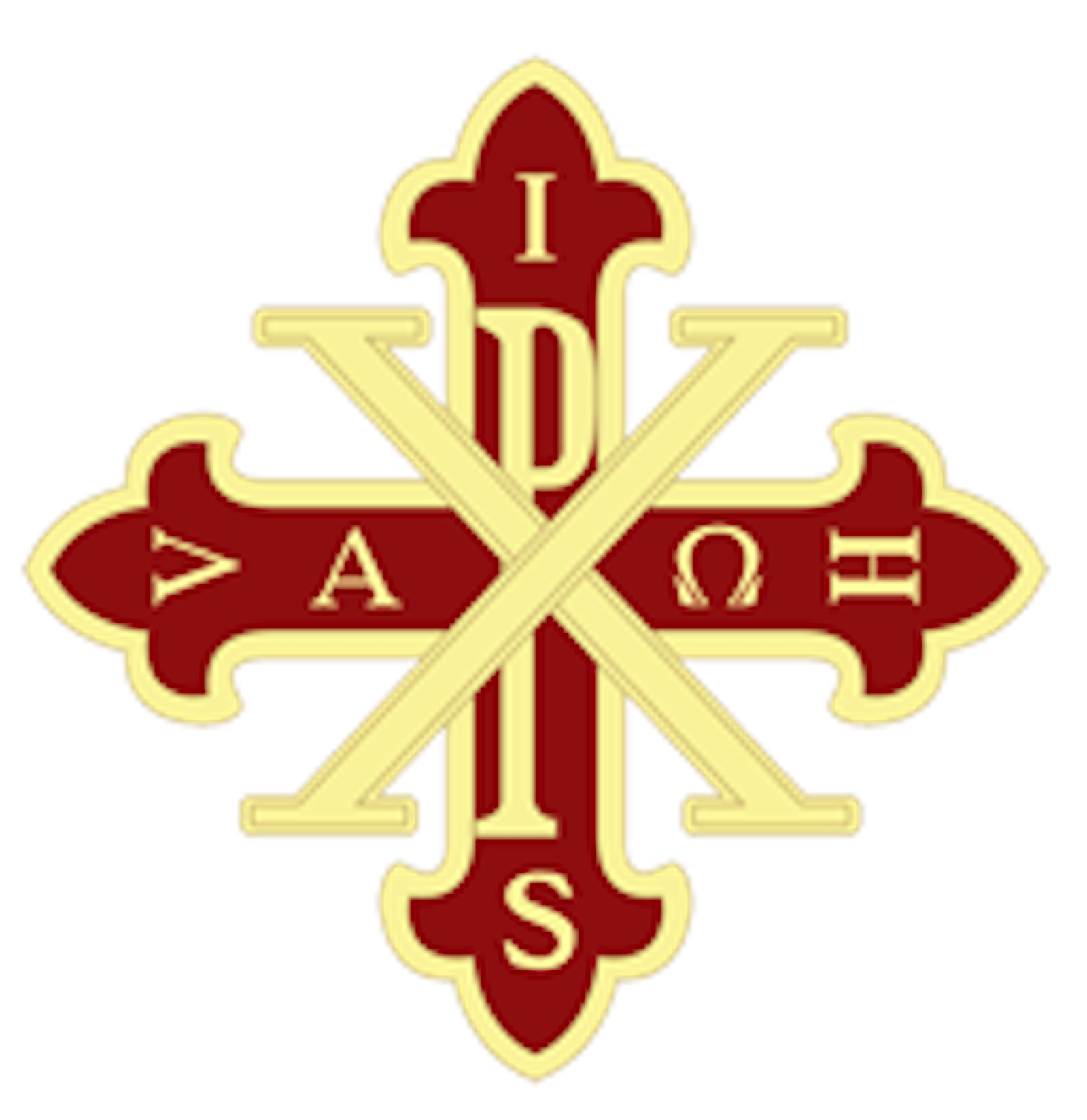
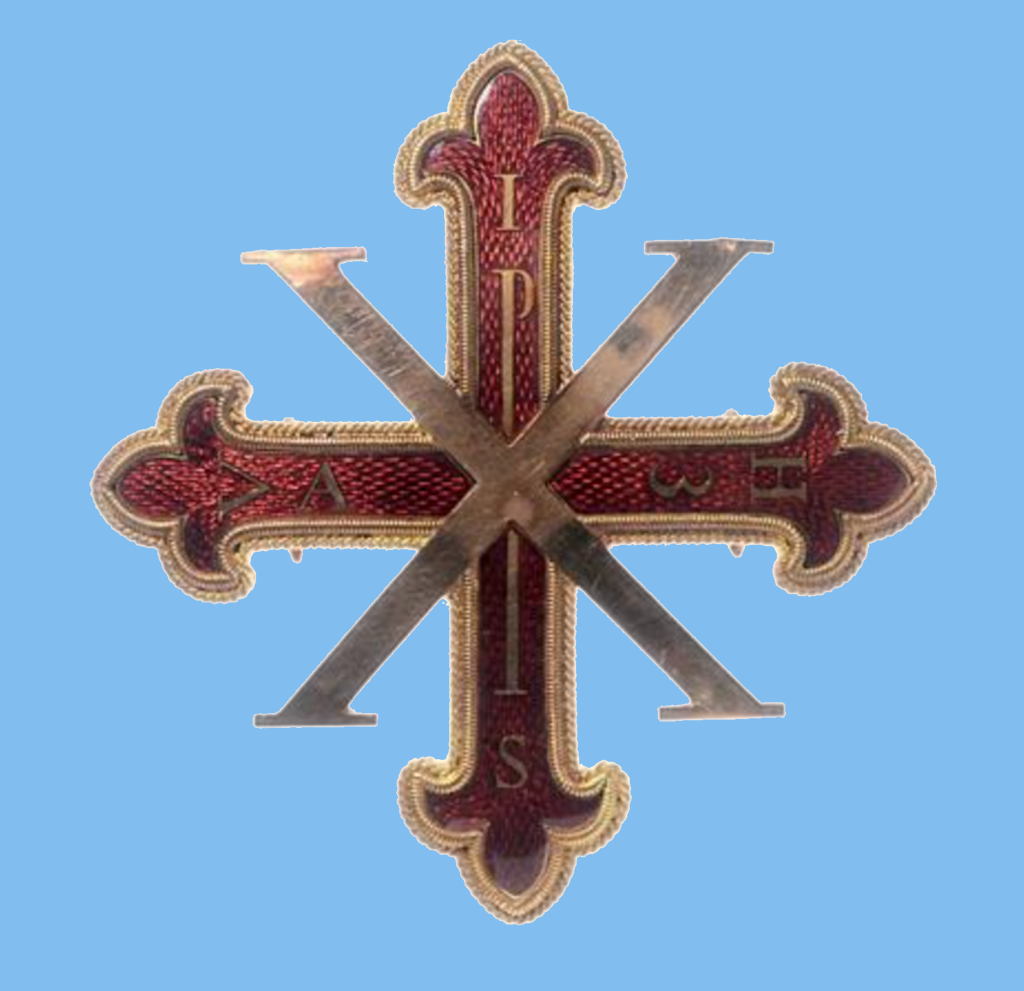
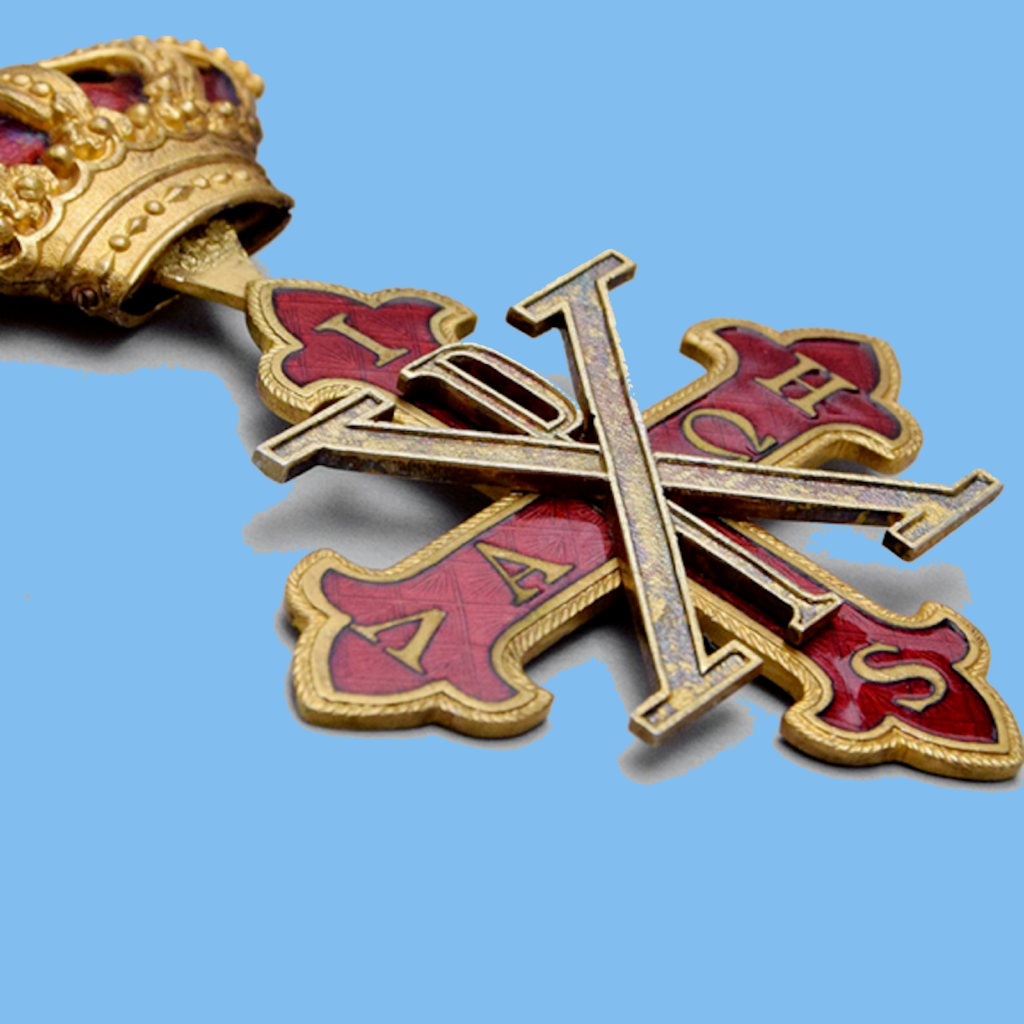
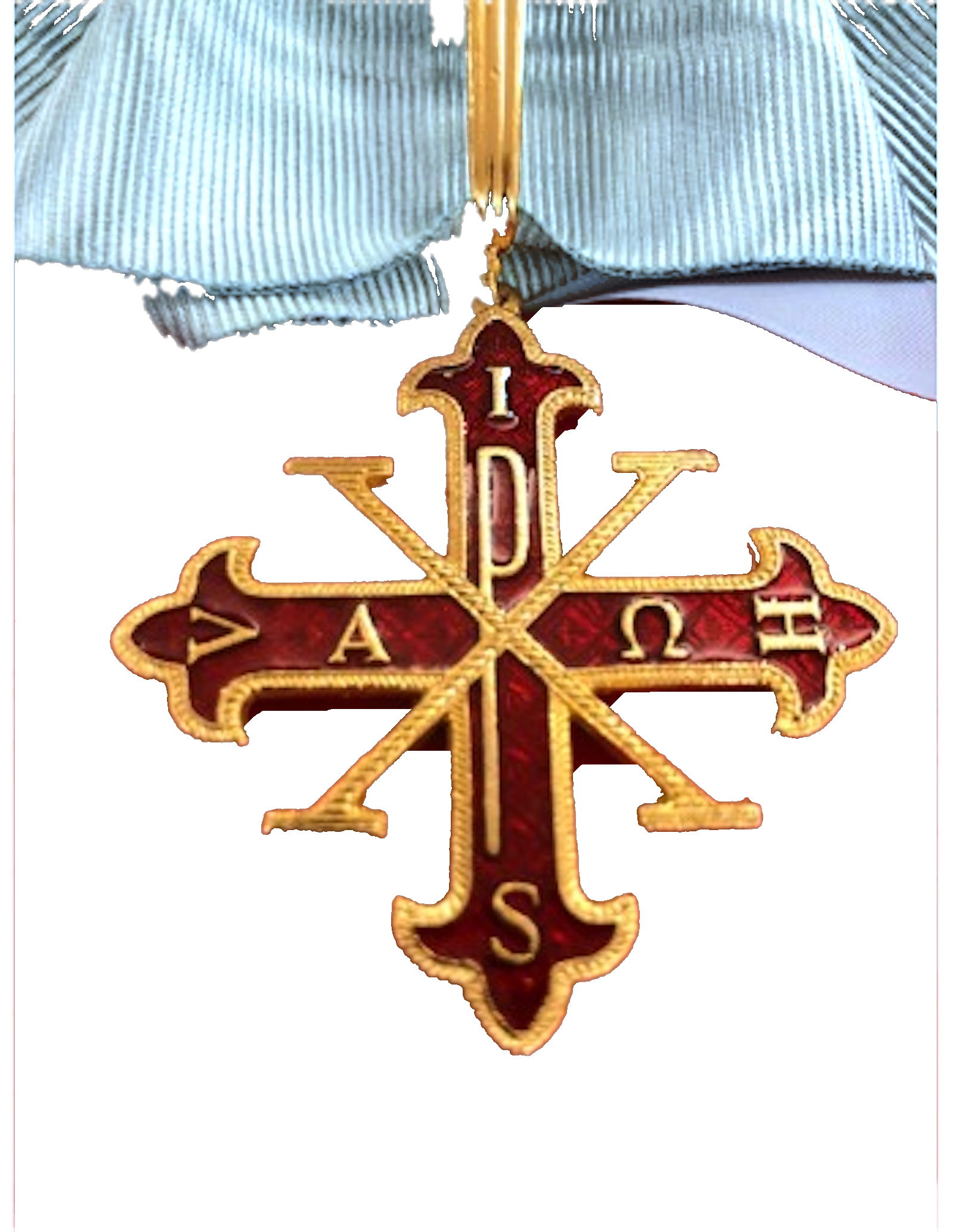
The Constantinian Cross is the central symbol of the Order. Its tradition is associated with the account of the vision said to have been vouchsafed to the Emperor Constantine before the Battle of the Milvian Bridge. The Cross serves as a reminder of the obligation incumbent upon every member of the Order to bear witness to the Christian faith through prayer, testimony, and works of charity. The Cross of the Order consists of a golden Greek cross, enamelled in purple and adorned with lilies. Above the Cross is set the royal crown. Upon the escutcheon it bears the Christogram XP, the monogram of the name of Christ (Xristos), accompanied by the Greek letters Alpha and Omega, the symbol of the beginning and the end. At the four extremities of the arms of the Cross appear the letters I H V S, referring to the motto of the Order: In Hoc Signo Vinces – “In this sign thou shalt conquer.” The Cross is invariably worn upon a sky-blue silk ribbon of a watered texture.
The Insignia of the Order
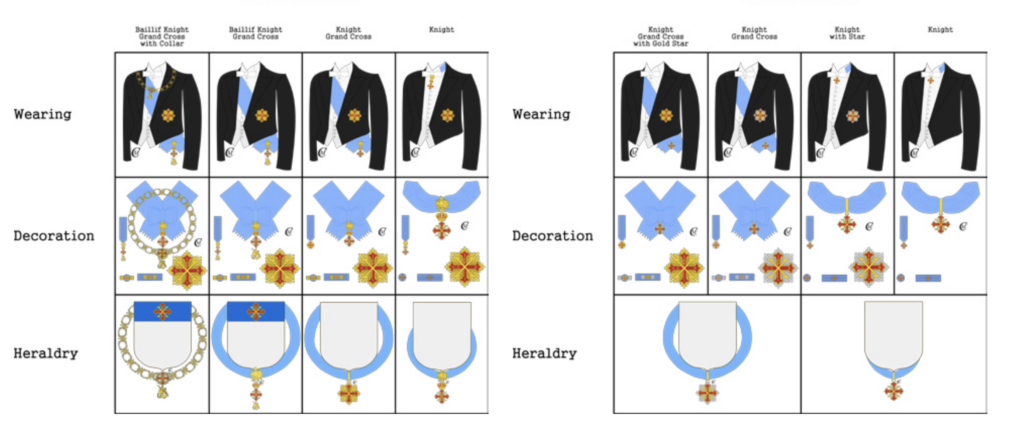
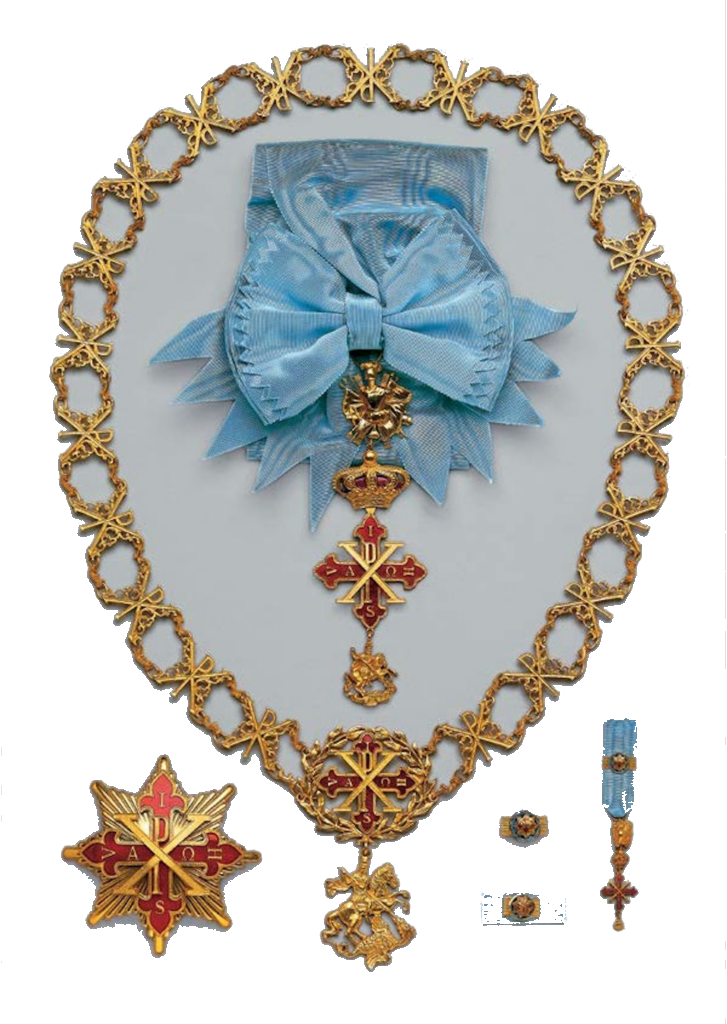
According to category and grade, the insignia of the Order may take various forms. The Constantinian Cross may be surmounted by a golden royal crown, which may in turn be suspended from a military trophy ensemble comprising flags, cannon, arrows, quivers, halberds, drums, and crossed swords supporting a suit of armour with a plumed helm.
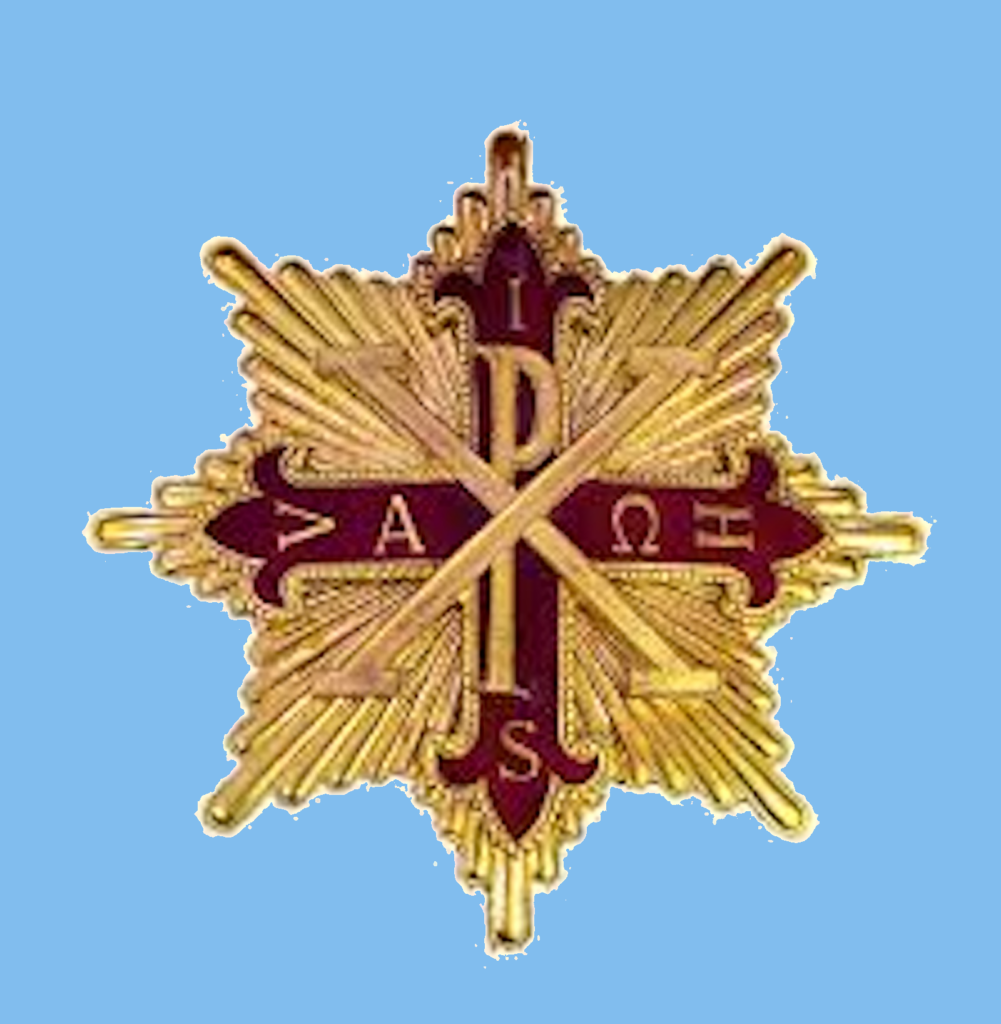
The breast star may appear in various forms: as a gold or silver star with eight groups of tapering rays bearing the Constantinian Cross superimposed, or as a square silver star with four groups of rays likewise bearing the Cross.
The sash – where it pertains to the respective grade – is worn diagonally across the shoulder, composed of sky-blue silk and bearing the suspended Cross of the Order.
The various grades and categories are further distinguished by different bar clasps or rosettes, with or without the Cross of the Order.
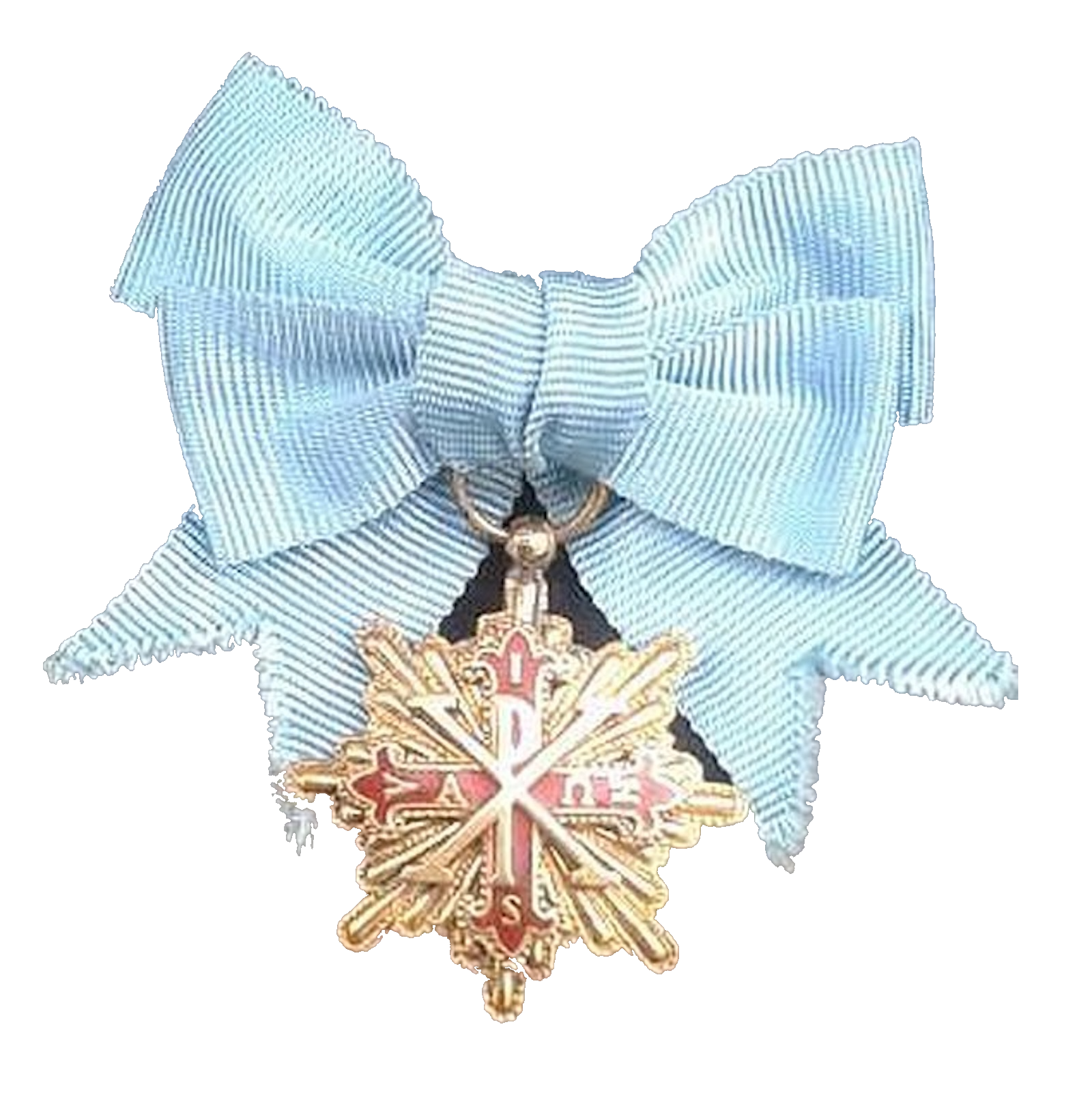
Depending upon the grade, the insignia may be worn as a sash, neck decoration, bow, or breast decoration.
The Order of Wearing for Gentlemen
- Full Evening Dress (White Tie): The Bailïfs, Grand Cross Knights of Justice bearing the Collar, shall wear the Collar, the sash with its appended decoration from the right shoulder to the left hip, and the golden breast plaque upon the left breast. The Grand Cross Knights shall wear the sash from the right shoulder to the left hip, together with the breast plaque of their grade upon the left breast. The sash is worn beneath the waistcoat; when the Grand Master is present, it is worn over the waistcoat, though beneath the coat. The Knights of Justice and Iure Sanguinis shall wear the neck decoration with its appended ornament, together with the breast star of their grade upon the left breast below the breast pocket. The Knights of Merit shall wear the neck decoration with its appended ornament. The Knights of Office shall wear the decoration upon a vertical ribbon on the left breast.
- Insignia with Dinner Jacket (Black Tie): Knights shall wear the badge (rosette) or miniature of their grade upon the left lapel.
- Day Dress (Gentlemen): With informal civilian dress, Knights shall wear the rosette of their grade in the left buttonhole of the jacket.
- With a morning coat (Cutaway), the rosette is generally worn; the miniature is likewise admissible as an alternative.
The Order of Wearing for Ladies
- Full Evening Dress (long gown): Ladies Grand Cross shall wear the sash from the right shoulder to the left hip, together with the breast plaque of their grade at the lower left of the bodice. Ladies of Justice and de Iure Sanguinis shall wear the decoration with ribbon bow upon the left side of the gown, together with the breast plaque of their grade at the lower left of the bodice. Ladies of Merit shall wear the decoration with ribbon bow upon the left side of the gown. Ladies of Office shall wear the decoration upon a vertical ribbon on the left side of the gown.
- Evening Dress: Ladies shall wear the miniature of their grade upon the left side of the gown.
- Day Dress (Ladies): Ladies shall wear the miniature of their grade upon the left side of the gown.
The Order of Wearing for Clergy
The Mozzetta: The ecclesiastical Bailïfs Grand Cross of Justice, the Grand Cross Chaplains de Iure Sanguinis, and the Grand Cross Chaplains of Merit shall wear the respective decoration upon a long neck ribbon, together with the breast plaque of their grade upon the left breast. The Chaplains of Justice, de Iure Sanguinis, and of Merit shall wear the respective decoration upon a neck ribbon, together with the breast plaque of their grade upon the left breast.
The Heraldry of the Order and the Privileges of its Knights
The heraldry of the Religious and Military Constantinian Order of Saint George constitutes a fundamental expression of its historical and institutional identity. It symbolically unites the Order’s religious mission with its juridical character and its place within the wider tradition of Catholic chivalric orders.
The Heraldic System of the Order
At the centre of the Order’s heraldry stands the Constantinian cross: a four-armed cross with fleur-de-lys terminals (croce gigliata), traditionally associated with the Christogram, the letters Alpha and Omega, and frequently accompanied by the motto In hoc signo vinces. This emblem directly recalls the vision of Emperor Constantine and underpins the sacred dimension of the Order.
The cross is not only worn as an insignia but is also incorporated into the personal armorial bearings of members. It serves as a visible sign of affiliation and may be displayed in various forms, whether as a badge pendent from a ribbon or as an external ornament to the shield.
Heraldry as an Expression of Rank and Membership
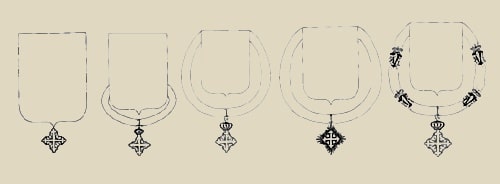
Heraldic usage within the Order reflects a clearly defined hierarchy, expressed through the form and display of its insignia. The various classes—such as Knights, Grand Crosses, and Bailiffs—are distinguished by:
- the use of star, sash, or collar,
- the position and treatment of the Order’s cross in relation to the shield,
- additional external ornaments denoting rank.
Grand Crosses, for example, bear the star in addition to the badge, whereas lower classes display the cross alone suspended from its ribbon. Such distinctions form part of a structured and regulated system of precedence.
Heraldry as a Manifestation of Privilege
The right to display the insignia of the Order within one’s armorial bearings constitutes in itself a significant privilege. It is associated with a broader body of rights historically attached to membership:
- the right to bear the Constantinian cross as an heraldic distinction,
- the right to wear the insignia and habit of the Order,
- a recognised position within the tradition of Christian orders of chivalry, comparable to other established religious orders,
- and, historically, the enjoyment of certain honours and immunities granted by princely or ecclesiastical authority.
Heraldry thus serves as the visible expression of these privileges, marking the knight’s membership in a body distinguished both spiritually and juridically.
Canonical Status and Historical Distinctiveness
The particular standing of the Order within the Church has fostered the development of a distinct heraldic tradition. The combination of ecclesiastical authority and historical autonomy continues to inform its symbolic language, setting it apart from purely state-based systems of honours.
Conclusion
The heraldry of the Constantinian Order is therefore far more than a matter of ornament. It constitutes an integrated system in which hierarchy, religious symbolism, and historically grounded privileges converge, giving visible form to the dignity and continuity of the Order.