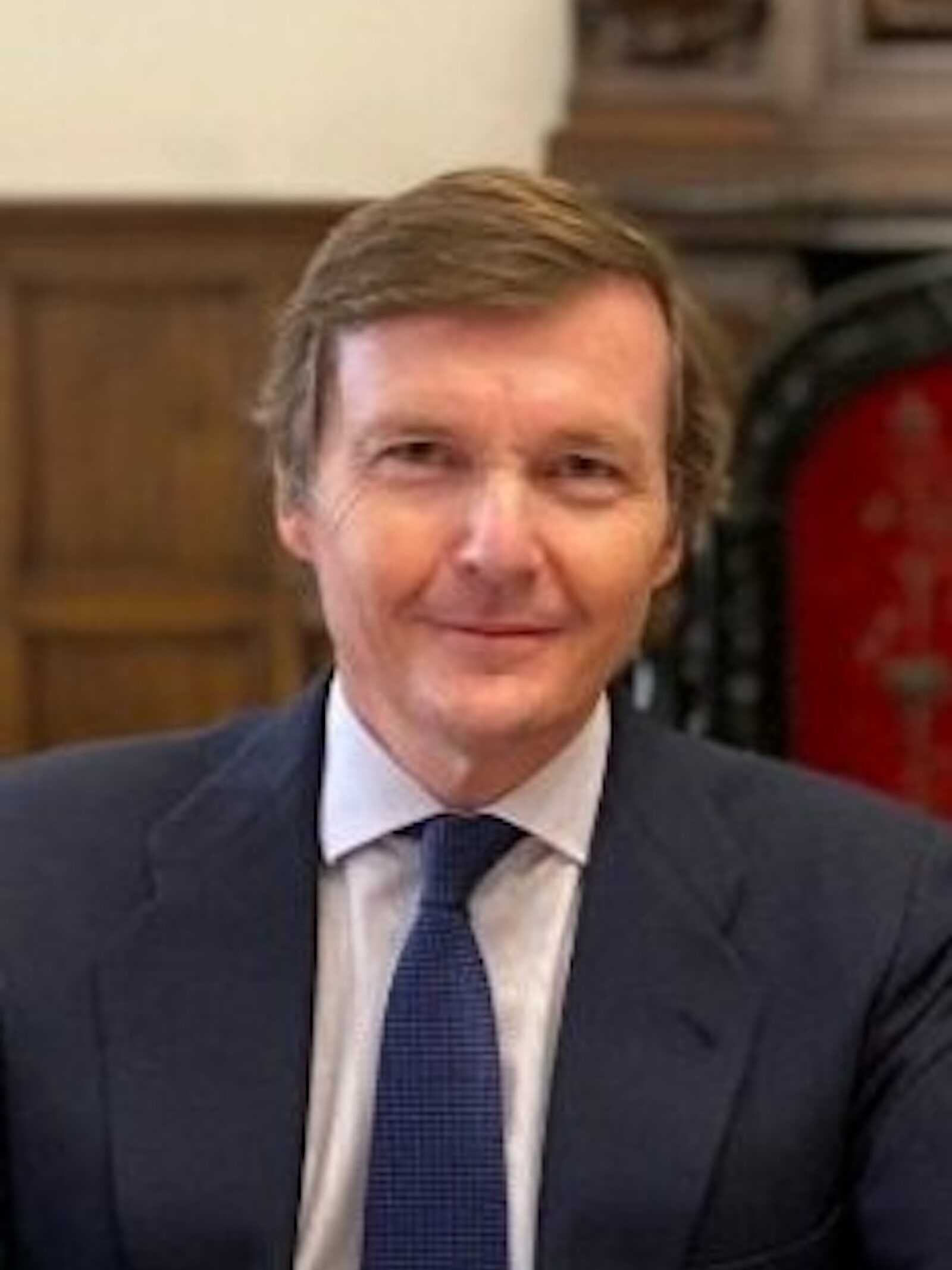
Prince Pedro, Duke of Calabria, Head of the House of Bourbon-Two Sicilies
H.R.H. Prince Don Pedro of Bourbon-Two Sicilies (born 1968) is the present Head of the House of Bourbon-Two Sicilies and the 21st Grand Master of the Constantinian Order of Saint George. He is the son of Infante Don Carlos of Spain, Duke of Calabria (1938–2015), and of Infanta Doña Anne d’Orléans (born 1938), daughter of the Count of Paris.
Prince Pedro unites within his person the inheritance of two great European royal dynasties: the Bourbons — as direct agnatic descendant of the Kings of the Two Sicilies — and the Orléans, the French branch of the House of Bourbon, whence his mother is descended. His line thus encompasses three centuries of European dynastic history.
| Full Name | Pedro de Borbón-Dos Sicilias y Orléans |
| Date of Birth | 25 September 1968, Madrid |
| Title | Duke of Calabria, Head of the House of Bourbon-Two Sicilies |
| Office | 21st Grand Master of the Religious and Military Constantinian Order of Saint George (since 5 October 2015) |
| Parents | Infante Don Carlos of Spain, Duke of Calabria (1938–2015), and Infanta Doña Anne d’Orléans (born 1938) |
| Consort | Sofía Landaluce Yanguas |
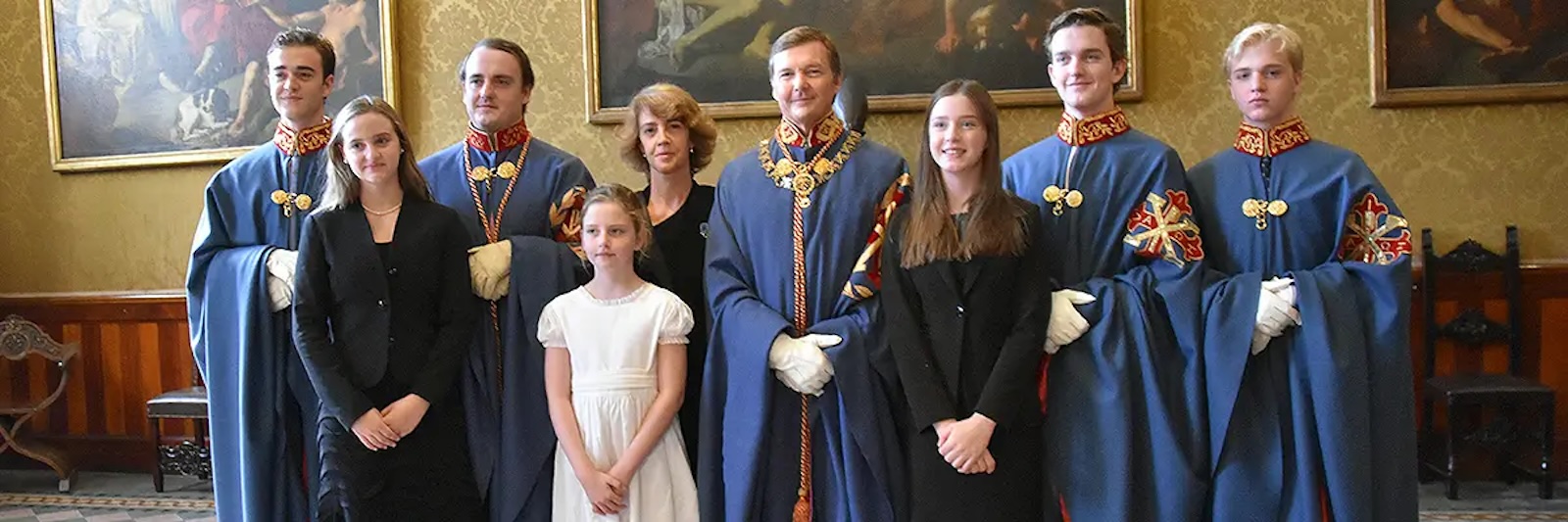
| Children | Princess Doña María, Prince Don Jaime (Duke of Noto, born 1993), Prince Don Juan, Prince Don Pablo, Prince Don Pedro, Princess Doña Sofía, Princess Doña Blanca |
| Dynastic Line | Calabria Line, principal line of the House of Bourbon-Two Sicilies |
Dynastic Legitimacy
The dynastic legitimacy of Prince Pedro as Head of the House and Grand Master of the Constantinian Order derives from an unbroken agnatic line of succession spanning eight generations, unanimously confirmed in 1983 and 1984 by five independent Spanish State authorities:
Ferdinand I., King of the Two Sicilies (1751–1825) — founder of the united monarchy
Francesco I. (1777–1830) — second King of the Two Sicilies
Ferdinand II. (1810–1859) — third King; father of Alfonso of Caserta
Alfonso, Count of Caserta (1841–1934) — Head of the House in exile following the death of Francis II
Carlos (1870–1949) — second-born son of Alfonso, progenitor of the Calabria Line
Alfonso II., Duke of Calabria (1901–1964) — son of Carlos, first Head of the Calabria Line after 1960
Carlos I., Duke of Calabria (1938–2015) — son of Alfonso II., 20th Grand Master
Pedro, Duke of Calabria (born 1968) — son of Carlos I., 21st Grand Master since 2015
This unbroken agnatic line across eight generations constitutes the foundation of the dynastic authority of the House. It conforms precisely to the rules of agnatic primogeniture which have governed the House of Bourbon-Two Sicilies since its foundation. Five independent Spanish State authorities confirmed this succession unanimously in the years 1983 and 1984.
The Spanish King Juan Carlos I conferred upon Prince Carlos, father of the present Grand Master, the rank of Infante of Spain — a signal act of dynastic recognition on the part of the Spanish Royal House.
The Father: Infante Carlos, 20th Grand Master
The father of Prince Pedro, Infante Carlos of Spain, Duke of Calabria (1938–2015), was the 20th Grand Master of the Order. Born in Naples, he spent his youth in exile, the members of the House of Bourbon-Two Sicilies having been expelled from Italy in the aftermath of the Second World War. As an Infante of Spain, he enjoyed a distinguished position of protocol at the Spanish Royal Court and was a close friend and confidant of King Juan Carlos I. His dedication to the Constantinian Order, his continuation of its religious traditions, and his stewardship of the cultural heritage of the House characterised his era as Grand Master. In 2014, shortly before his death, he subscribed the Atto di Riconciliazione Familiare — the Act of Family Reconciliation with the Castro Line — in the hope of resolving the decades-long dynastic dispute. His son Don Pedro carried forward this work of reconciliation until the Castro Line unilaterally repudiated the terms of the Act in 2016.
The Chief Line of the House of Bourbon-Two Sicilies
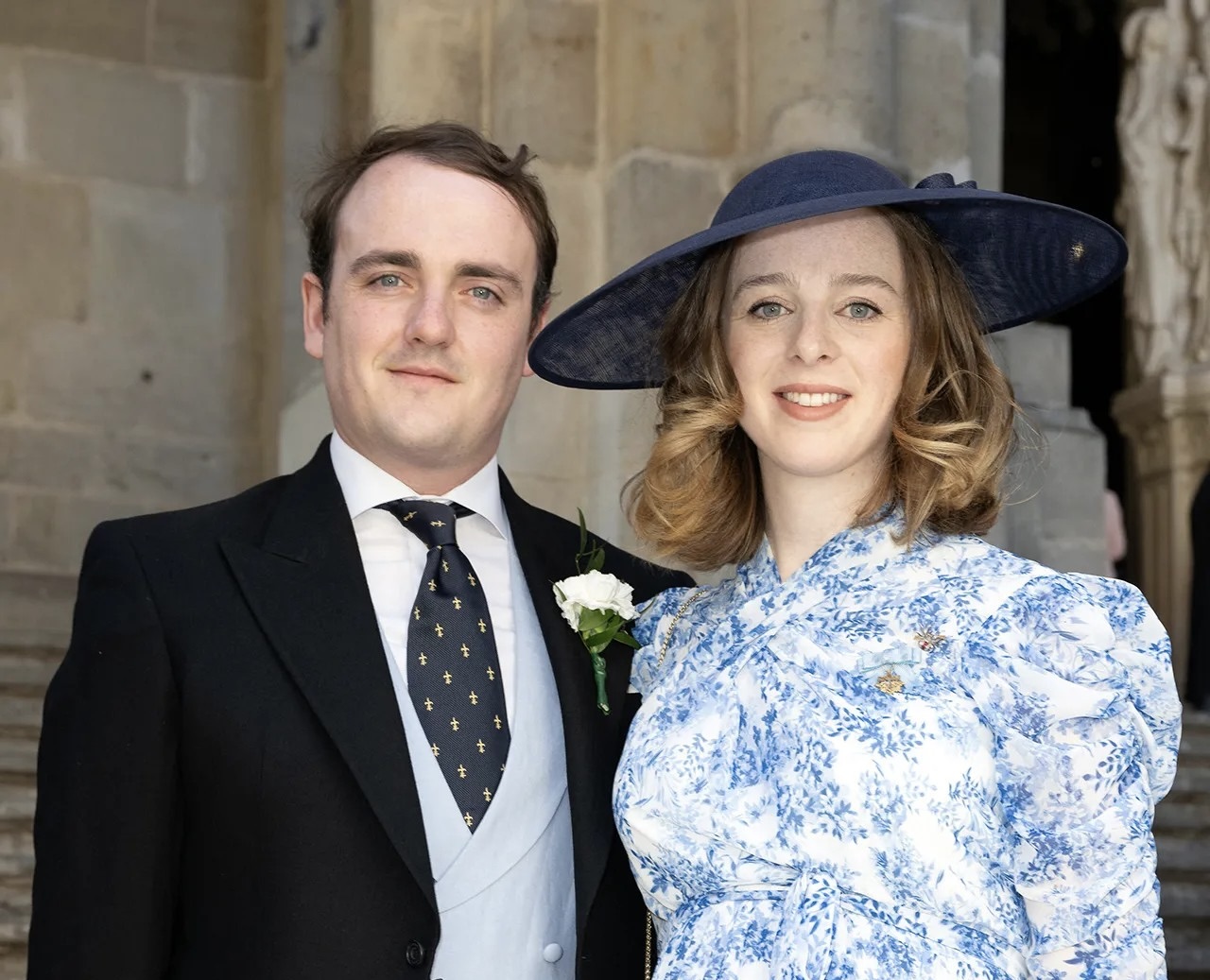
Prince Pedro is married to Sofía Landaluce Yanguas. Together they have seven children; the eldest son is Jaime, Duke of Noto (born 1993), who shall continue the dynastic line. Prince Jaime has appeared increasingly in public, accompanying his father in the representative duties of the Order and of the House. He read at distinguished European universities and is preparing himself with care for his future rôle as heir to the House. Prince Jaime is married to Princess Charlotte, born Lady Charlotte Diana Lindesay-Bethune (born 1993).
The Calabria Line is accordingly the only one of the two lines of the House which possesses male descendants. The Castro Line, with its present line chief Carlo, Duke of Castro, retains its last male representative — a genealogical fact which in 2016 prompted the unilateral conversion of succession to absolute primogeniture, a change not recognised by the Calabria Line.
The following interactive family tree shows the descendants of Ferdinand II. and the division into the Calabria Line (principal line, marked in red) and the Castro Line (cadet line, marked in blue). Names bearing Wikipedia links are clickable; nodes may be expanded and collapsed by clicking upon the arrow buttons.
With Prince Jaime, Duke of Noto, the succession of the House of Bourbon-Two Sicilies passes into the next generation — after more than three centuries of dynastic continuity, from the foundation of the Kingdom of Naples-Sicily by Charles of Bourbon in 1734 to the present day.
Relationship with the Spanish Royal Family
Prince Pedro of Bourbon-Two Sicilies, Duke of Calabria, Count of Caserta and Head of the Royal House of the Two Sicilies, belongs in Spain to the family of the King. His late father, Infante Don Carlos, was a first cousin of King Juan Carlos I. Prince Pedro is a second cousin of King Felipe VI. and serves His Majesty as President of the Council of the four Spanish Military Orders of Santiago, Calatrava, Alcántara and Montesa.
On 27 June 1972, the then Head of the Spanish Royal House, His Royal Highness Don Juan de Borbón y Battenberg, Count of Barcelona, set forth in a formal letter the order of succession in accordance with the Constitution of 1876. In that order there appeared, inter alia, Don Juan, Count of Barcelona; Prince Juan Carlos; Felipe de Borbón y Grecia (King Felipe VI.); Elena and Cristina; Don Carlos, Duke of Calabria, Head of the House of the Two Sicilies; Don Pedro, Duke of Noto (at present Duke of Calabria and Grand Master).
This arrangement was grounded in the Constitution of 1876, subsequently superseded by the Constitution of 1978. Under the present Constitution, the succession falls firstly to the two daughters of King Felipe VI. and thereafter to the further descendants of King Juan Carlos. The Royal Family of Spain comprises today King Felipe VI., Queen Letizia, their two daughters (Leonor, Princess of Asturias, and Infanta Sofía), together with King Juan Carlos and Queen Sofía. To the family of the King belong furthermore the sisters of King Felipe VI. and their children, the sisters of King Juan Carlos and their children, and Prince Pedro, his mother, his sisters and their children.
The Order under Prince Pedro
As 21st Grand Master, Prince Pedro continues the Sacro Militare Ordine Costantiniano di San Giorgio. The Order today maintains delegations in numerous countries throughout Europe and the wider world, uniting its historical military tradition with an active charitable and religious vocation. Its principal endeavours are as follows:
Ecclesiastical Restoration: The financing and supervision of the restoration of historic churches and religious works of art, in particular in southern Italy.
Humanitarian Assistance: Support for charitable organisations and humanitarian projects in Europe and overseas.
Scholarship Programmes: The advancement of young Catholics through educational schemes and bursaries.
Preservation of Cultural Heritage: The documentation and dissemination of the history of the Order and of the House of Bourbon-Two Sicilies.
Religious Patronage: Support for the Church in its apostolic and social undertakings.
The pontifical foundation of the Order — the Brief of 1699 and the Bull Militantis Ecclesiae of 1718 — defines the office of Grand Master as an independent dynastic inheritance, separate from the secular succession to the throne. This independence secures the continuity of the Order irrespective of political change. The Holy See has, in its ecclesiastical correspondence, invariably addressed the Head of the Calabria Line as the lawful Grand Master.
The commissions and delegations of the Order under the leadership of Prince Don Pedro are active in the following countries: Spain, Italy, Germany, France, Austria and Liechtenstein, the United Kingdom and Ireland, the United States of America, Mexico, Argentina, Brazil, Australia, Belgium, the Netherlands, and further countries. Each delegation unites the historical tradition of the Order with the local ecclesiastical and social life.
Engagement and Outlook
Prince Pedro engages himself personally in the activities of the Order and represents the House at official occasions throughout Europe and the wider world. His dedication is directed in particular to the union of European dynastic tradition with contemporary charitable action. He is resolute that the Order shall be no mere institution of representation, but shall actively discharge its social and ecclesiastical duties.
As Grand Master, he cultivates close relations with ecclesiastical and secular institutions throughout Europe. The foremost concern is not dynastic self-presentation, but the continuation of a tradition of centuries in the service of the Church and of society. In this connexion, Don Pedro invariably emphasises the character of service and obligation which attaches to the office of Grand Master — to be Grand Master is not a privilege, but a responsibility.
With Prince Jaime, Duke of Noto, the next generation of the House stands in readiness. After more than 290 years of dynastic continuity — from the foundation of the Kingdom of Naples-Sicily by Charles of Bourbon in 1734 to the present day — the House of Bourbon-Two Sicilies carries forward its history as a living European dynastic tradition.